The Search for the Perfect Sugar Alternative
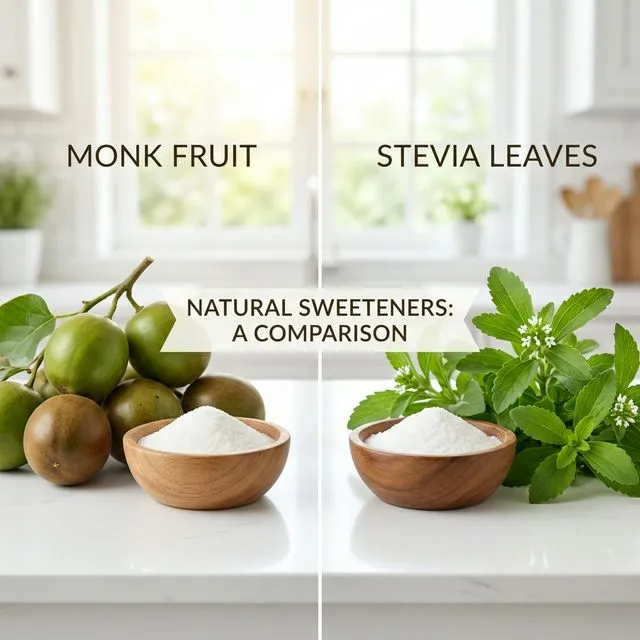
As consumers increasingly reject artificial sweeteners like Aspartame and Sucralose, the demand for natural, zero-calorie alternatives has exploded. The two titans in this space areSteviaandMonk Fruit. Both are natural, plant-based, and zero-calorie, but they have distinct differences that can make or break a product formulation.
Here is a side-by-side comparison to help you choose the right one for your needs.
1. Taste Profile
- **Stevia:**Extracted from the leaves of Stevia rebaudiana.
- Pros: Intense sweetness (200-300x sugar).
- Cons: Notorious for a bitter, metallic aftertaste, often described as “licorice-like.” Requires masking agents or careful blending (e.g., Reb M is cleaner but more expensive).
- **Monk Fruit:**Extracted from the Siraitia grosvenorii fruit.
- Pros: Clean, neutral sweet taste that closely mimics sugar. No bitter aftertaste.
- Cons: Can have a slight fruity note at very high concentrations.Winner:****Monk Fruitwins on pure taste profile, offering a closer match to sugar without the bitterness.
2. Cost & Availability
- **Stevia:**Widely grown globally, easy to cultivate.
- Status: Commodity ingredient. Low cost, high availability.
- **Monk Fruit:**Grows only in specific regions of Southern China and is difficult to cultivate.
- Status: Premium ingredient. Significantly more expensive than Stevia (often 2-4x the price).Winner:****Steviais the clear winner for cost-sensitive mass-market products.
3. Regulatory & Labeling
- **Stevia:**Approved in almost every major market. Labeled as “Stevia Leaf Extract” or “Steviol Glycosides.”
- Monk Fruit:Approved in US, Canada, China, Japan, and other huge markets, butstill waiting for full EU approvalas a sweetener (though allowed as a flavoring). Labeled as “Monk Fruit Extract” or “Luo Han Guo Juice Concentrate.”Winner:****Steviahas broader global regulatory approval, specifically in Europe.
4. Stability & Application
- **Heat Stability:**Both are heat stable and work well in baking.
- **pH Stability:**Both are stable in acidic beverages.
- **Solubility:**Both are highly water-soluble.**Winner:****Tie.**Both are excellent for beverages, dairy, and baked goods.
The Verdict: Which One Should You Use?
-
Choose Stevia if:* Cost is a primary driver.
-
You are launching a product in Europe.
-
You are formulating a product with strong flavors (like coffee or chocolate) that can mask the aftertaste.
-
Choose Monk Fruit if:* Taste is paramount.
-
You are targeting a “Premium” or “Clean Label” demographic.
-
You want “No Added Sugar” claims without the “diet taste.”
Pro Tip: The Hybrid Approach
Many formulators are now using a blend of Monk Fruit and Stevia. By using a small amount of Monk Fruit to round out the flavor profile of Stevia, you can achieve a better taste than Stevia alone, while keeping costs lower than using 100% Monk Fruit.
At ToNutra, we offer extracts of both Monk Fruit and Stevia, as well as custom blends. Contact us to find your sweet spot.