Introduction to EU Certification
In the modern botanical ingredient and neutraceutical industries, the EU leaf logo is more than just a regulatory badge—it is a mandatory passport to access the health-conscious European market and a universal symbol of premium quality. Securing EU Certification ensures that your botanical extracts and plant-based proteins meet some of the most rigorous agricultural and processing standards in the world.
Applying for this certification can seem daunting, especially when dealing with complex global supply chains. However, by breaking the process down into critical, actionable phases, manufacturers and suppliers can smoothly achieve compliance under Regulation (EU) 2018/848.
Step 1: Understand the Core EU Principles (Regulation (EU) 2018/848)
Before submitting an application, your entire supply chain must align with the foundational rules of European production. This involves strict prohibitions and mandates at every level:
- **Zero Synthetic Chemicals:**The absolute prohibition of synthetic pesticides, herbicides, and artificial fertilizers during farming.
- **Non-GMO Mandate:**Genetically Modified Organisms (GMOs) are completely forbidden across the entire production and processing cycle.
- **Soil and Environmental Health:**Farms must undergo a structural conversion period (typically ranging from 2 to 3 years) before any harvested crops can be officially sold as "".
- **Processing Integrity:**During extraction and powdering, cross-contamination with non- materials must be prevented. Strict documentation regarding cleaning protocols (such as CIP) and separation strategies is required.
Step 2: Select an Authorized Control Body
You cannot self-certify as EU. Certification must be granted by an independent, EU-recognizedControl Body (CB)orControl Authority (CA).
1.**Identify a Local or Regional Partner:**Choose a certification agency that operates in your country but is explicitly authorized to issue certificates equivalent to EU standards (e.g., Ecocert, CERES, Kiwa BCS, or Control Union). 2.**Submit an Initial Inquiry:**Contact the body to acquire the exact forms and clarify any doubts regarding the scope of your specific botanical ingredients (e.g., verifying allowed extraction solvents like water or ethanol).
Step 3: Implement an Management Plan (OMP)
Your Control Body will require a comprehensive overview of how your facility maintains integrity. You must draft an**System Plan (OSP)**or Management Plan detailing:
- **Sourcing:**Clear documentation and purchasing records proving that all raw materials (e.g., raw pine bark, dragon fruits, or mung beans) are already certified EU.
- **Facility Mapping:**Plant layouts showing distinct segregation between and conventional processing lines to eliminate cross-contamination risks.
- **Traceability Flow:**A robust tracking system correlating raw materials, extraction batch numbers, and final shipped products (e.g., powders).
Step 4: The On-Site Audit and Inspection
Once your documents are submitted, the Control Body will schedule a rigorous on-site inspection.
- **Physical Verification:**An auditor will walk through your farm or manufacturing plant, inspecting cleaning logs, storage areas, and processing equipment.
- **Mass Balance Audit:**They will conduct a trace-back exercise. For instance, if you sold 1,000 kg of Pea Protein, the auditor will check your purchase receipts to verify you bought enough raw peas to produce that precise amount, accounting for documented yield ratios.
Step 5: Addressing Non-Conformities and Certification
If the auditor finds any discrepancies (known as non-conformities), you will be given a set period to implement corrective actions.
- **Corrective Action Plan:**You must provide photographic or documented proof that the issues have been resolved.
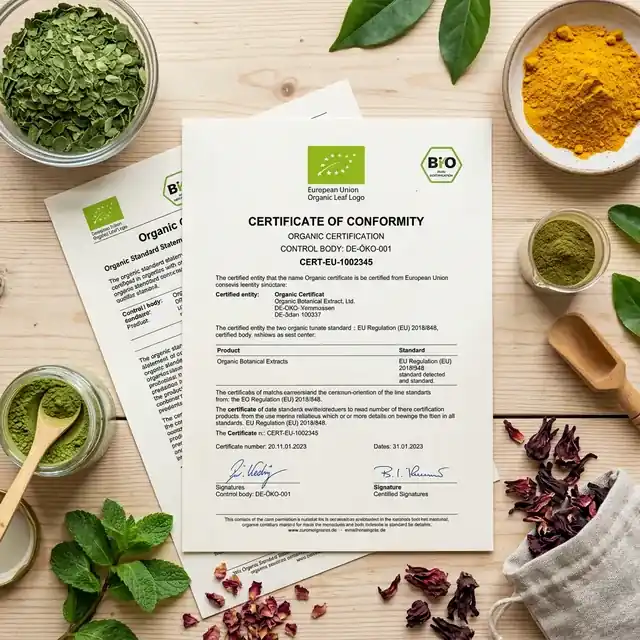
- Receiving the Certificate:Once approved, you will receive yourCertificate of Conformity, effectively allowing you to affix the EU leaf logo (with the corresponding Control Body code number) to your packaging and marketing materials.
The Importance of Certificates of Analysis (COA) (COAs)
Holding the facility certification is only the first part. For B2B suppliers shipping products to Europe, obtaining a**Certificate of Analysis (COA)**through the TRACES (Trade Control and Expert System) platform for each specific export batch is mandatory. This document acts as a passport, proving to European customs that the specific batch on the ship is genuinely.
AtToNutra, our comprehensive portfolio—from Pine Bark Extract to Pea Protein—is strictly audited under EU standards. We provide complete transparency and seamless COA documentation for every batch, making your supply chain absolutely bulletproof.